
By the Unique Outdoor Lighting crew — NJ installs · Updated 2026-07-18
Good landscape lighting is not more fixtures — it is the right layers, composed for one specific property and judged after dark. This guide walks the layers a designer actually works with, what each one is for, and the mistakes that make a yard look like a parking lot.
How do you design landscape lighting?
In layers. A strong design treats the property as a sequence — arrival, architecture, planting, outdoor living, and security — and lights each layer with intent instead of scattering fixtures wherever there is a bed to hide them in. The layers are composed together so the finished night view reads as one picture.
The design also has to be made on the property, not on a template. Sightlines, the architecture worth tracing, the trees worth lighting, and how you actually use the space after dark are all specific to one home.
What is path lighting, and where does it belong?
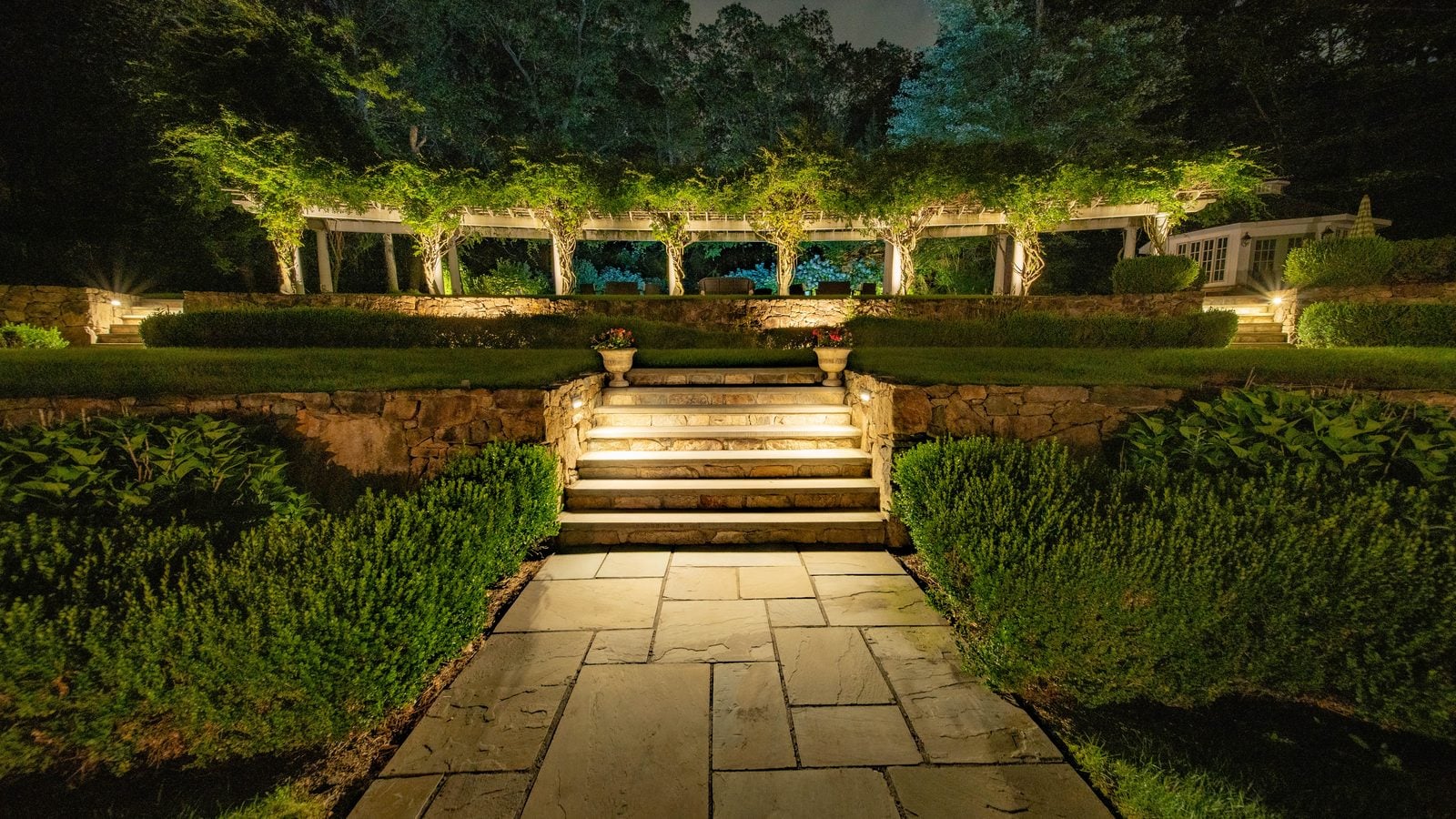
Path lighting is low-level illumination along walkways, entries, and driveways — the layer that makes movement through the property safe and obvious. Done well, it uses fewer fixtures than people expect, placed where the path turns or changes level, casting pools of light rather than a continuous strip.
The classic mistake is the runway: identical fixtures marching down both edges of a straight walk. Light the route, not the edges.
What is uplighting, and what should you uplight?
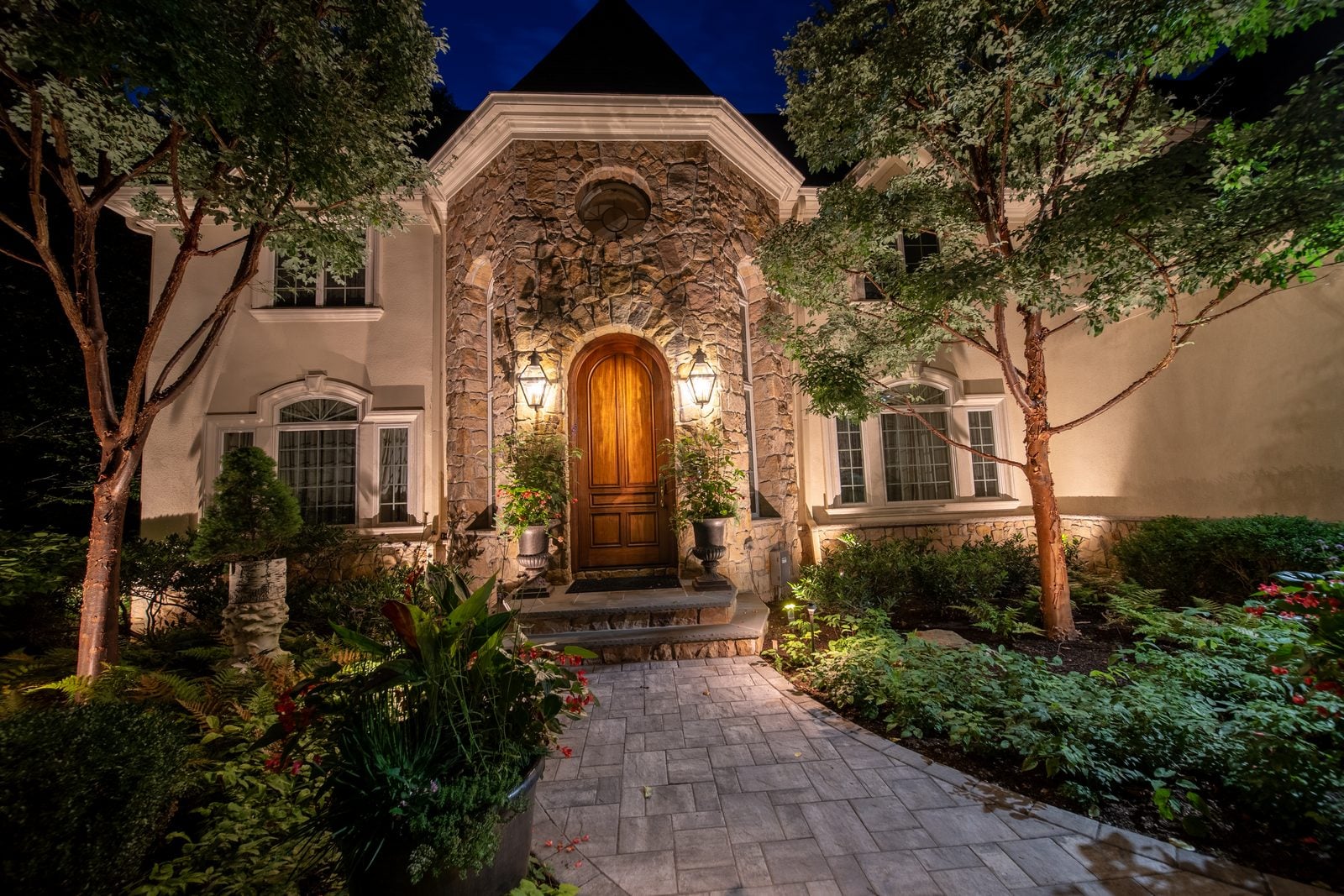
Uplighting places fixtures at ground level aimed upward — the layer that gives a property drama. It is what turns a mature tree into a feature, pulls texture out of stone and brick, and gives the house presence from the street. Trees, shrubs, and architecture are the classic subjects.
Restraint is the skill. A few well-chosen subjects, properly aimed, beat a floodlit yard every night of the week.
What is moonlighting?
Moonlighting is downlighting from height — fixtures mounted high in a mature tree, aimed down through the branches, casting soft, dappled pools that read like moonlight on the lawn. It is the most naturalistic effect in the toolkit, and one of the reasons properties with big trees light so beautifully.
Because the fixtures sit high and shielded, the effect is all light and no visible source — the opposite of glare.
How do you light a home's facade?
By tracing the architecture rather than flooding it. Facade and accent lighting picks out what the house does well — columns, gables, stonework, entries — and lets the rest fall away into shadow. Grazing light up a textured wall pulls out the material; a soft wash keeps a flat elevation from going dead.
The goal is a house that reads as architecture at night, not a building with lights pointed at it.
How should patios, decks, and outdoor living areas be lit?
Lower and softer than the rest of the property. Living areas want light for people — comfortable levels you can sit in for hours, sources shielded from eye level, and layers you can dim as the evening goes on. Deck, patio, and outdoor living lighting is its own layer of the design, not an afterthought.
Done right, it changes how much you use the space: the patio stops closing at sunset.
What role do controls play in a lighting design?
Controls are how the design behaves over time. Astronomical timers track dusk as it shifts across the seasons, so the system comes on when it should without reprogramming. Smart controls go further: schedules, zone-by-zone brightness, and the whole system on your phone.
Zoning is the design decision underneath — separating arrival, facade, and living areas so each can run at its own level and schedule.
What landscape lighting mistakes should homeowners avoid?
Most bad lighting comes from the same short list. Every one of these is avoidable at the design stage, and expensive to unwind afterward.
Over-lighting — brightness is not the goal; contrast is what makes a property read at night
Glare — visible bulbs and unshielded fixtures at eye level ruin otherwise good designs
The runway — evenly spaced path lights down both edges of a straight walk
Mixed color temperatures — warm here, cold there, and the property stops reading as one picture
A transformer with no headroom — the system that can never grow
Skipping night focusing — fixtures aimed in daylight and never corrected after dark
How does the design process work at Unique Outdoor Lighting?
Four steps, in the order the work actually happens. It starts with a free consultation, where we walk the property to understand sightlines, the architecture worth tracing, and how you use the space after dark. Then a custom design, built in layers around your property.
Installation is our own crew, not subcontractors: buried wiring, transformers sized with headroom, beds left the way we found them. And the system is finished at night — every fixture aimed and dimmed after dark, with service on everything we install for as long as you own it.